
Table of Contents
Karnataka’s New Land Rules Explained: What They Mean for Managed Farmland Buyers in 2026
If you’re exploring managed farmland near Bangalore, you’ve probably wondered:
“What if rules change in future?” or “How safe is my farmland purchase legally?”
Recently, Karnataka has introduced reforms to simplify certain land-use processes—especially for small industries, renewable energy projects, and urban master plan zones.
These updates don’t mean farmland automatically becomes residential, but they do signal that Karnataka is trying to make governance faster and more transparent.
Let’s break it down in simple terms—and most importantly, what it means for managed farmland buyers and families planning long-term ownership.
What Exactly Changed in Karnataka’s Land Rules?
The key reforms being discussed include:
1) Some activities may not require “conversion” in specific cases
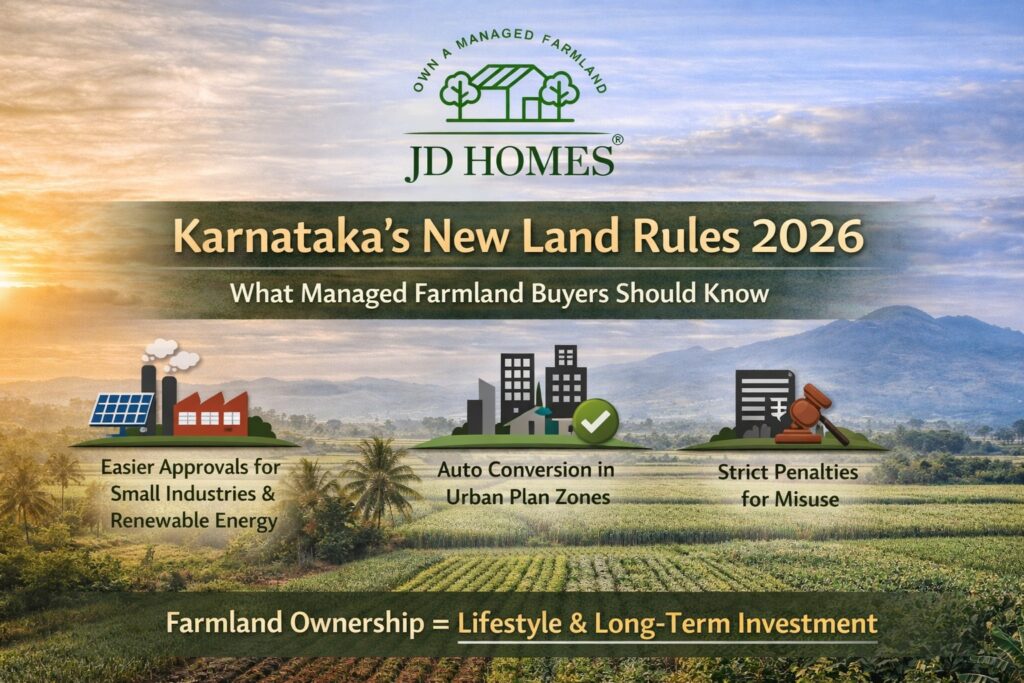
As reported, small-scale industries on agricultural land up to 2 acres and renewable energy projects (solar, wind, biomass, waste-to-energy, storage, etc.) may be exempt from needing prior conversion permissions.
What this means:
The state is reducing approval steps for specific economic activities—primarily business/energy uses.
2) “Auto-conversion” concept for lands inside urban master plans
If agricultural land falls under urban master plan zones (like residential/commercial zones), it may be treated as “converted” automatically for non-agri use in that planning context—removing a separate conversion step.
What this means:
In certain planned urban areas, land-use classification can become simpler—especially for layout approvals.
3) Online conversion applications + strict timelines
The reforms also mention moving processes online, where Deputy Commissioners must issue conversion orders within 30 days, and if not issued within the timeline, the application may be treated as provisionally approved. (News First Prime)
What this means:
Less delay, more predictable timelines.
4) Strict penalties to prevent misuse
Along with relaxed procedures, there are also penalties for violations—including fines and continuing penalties (reported as ₹1 lakh + daily penalty), and recording penalties in land records to ensure compliance.
What this means:
The government is trying to prevent illegal diversion and misuse while streamlining approvals.
Another Important Update: Change-of-Use for Older Purchases (Pre-2020)
Separately, reports also highlight that landowners who purchased agricultural land before 2020 for certain approved non-agricultural purposes but couldn’t execute projects may be able to apply to change how that land is used, through a defined approval process. (The Times of India)
What this means:
It offers a structured path for older stuck projects to realign with the current surrounding land-use reality.
What Does This Mean for Managed Farmland Buyers?
Here’s the real buyer takeaway:
1) Managed farmland is still primarily agricultural ownership
When you buy a managed farmland plot, the goal is typically:
- Weekend living / nature stays
- Long-term asset growth (land appreciation)
- Plantation and lifestyle ownership
- A gated, managed community experience
So these reforms are not a “signal to convert farmland into plots”—they’re mostly about streamlining specific categories like energy/industry and urban-planning alignment. (News First Prime)
2) Legal clarity becomes even more important
Because rule changes often create confusion in the market, buyers should focus on:
- Clear title & documentation
- Proper survey demarcation
- Transparent agreements
- Verified layout approach (community planning + management model)
This is where organized, professionally managed farmland projects stand out from unorganized “layout-style farmland sales.”
3) Buyers should avoid “assumptions” and stick to compliant ownership
A common mistake: people assume farmland = future residential plot.
In reality, land use depends on:
- Government rules at that time
- Master plan zoning and permissions
- Legal process compliance
- District-level approvals (where applicable)
The safer approach is to buy farmland for what it is today:
✅ a lifestyle + long-term land asset (with proper legal structure)
How JD Homes Helps Buyers Stay on the Safe Side
At JD Homes, the managed farmland approach is built for long-term ownership comfort:
✅ Individually owned, registered plots
✅ Community-based development (roads, fencing, common amenities)
✅ Plantation + upkeep + security + on-ground team
✅ A lifestyle ecosystem that encourages real usage (not just paper investment)
This aligns with what buyers want today: peace, weekend living, and stress-free ownership near Bangalore—with professional project management.
FAQs (Add at end of blog for SEO)
Q1. Do Karnataka’s new rules mean farmland becomes residential?
Not automatically. These reforms mainly simplify certain approvals and specific categories. Actual use depends on zoning, approvals, and compliance. (News First Prime)
Q2. Are there penalties for illegal non-agricultural use?
Yes, reports mention strict penalties and recording violations in land records. (News First Prime)
Q3. Is managed farmland still a good lifestyle investment near Bangalore?
Yes—demand remains strong for nature-based weekend living, gated security, and managed plantation ecosystems, especially among working professionals.